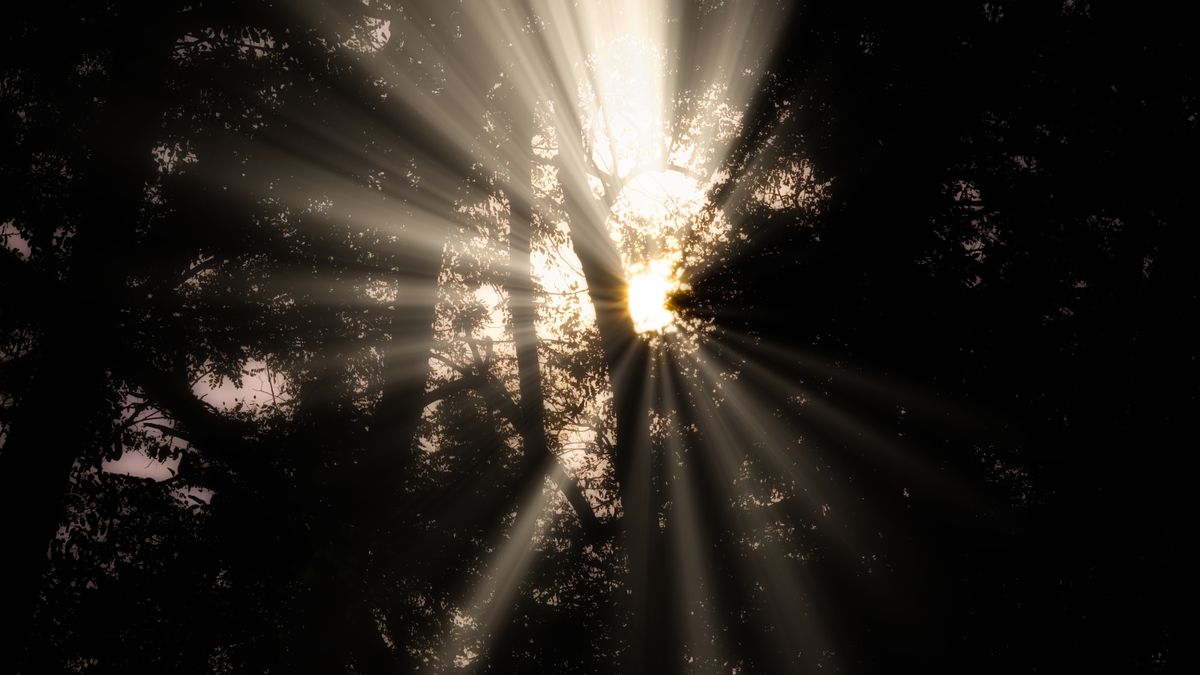
Is light matter? No — and the proof is in your hand. You can hold a stone, a cup of water, or a fistful of air, because all of those are matter, with mass and substance. But you can't hold a sunbeam, weigh a torch beam, or fill a bottle with light. Light is made of photons, which have no mass and aren't made of atoms, so it isn't matter at all. Yet it's far from nothing: light carries real energy and can even push on things. Here's how something weightless can be so powerful.
Is light matter? The short answer
Matter is anything that has mass and takes up space — atoms and the things built from them. By that definition, light fails on both counts. A photon has zero rest mass, and a beam of light isn't a collection of atoms. So light is not matter; it's a form of energy — electromagnetic radiation — that travels through space.
That doesn't make light unreal or unimportant. It just puts it in a different category: not a substance, but a carrier of energy and momentum. The deeper question of what a photon actually is — wave, particle, or both — we tackle in our guide to whether light is a wave or a particle.
Why does light have no mass?
When we ask is light matter, the question of mass settles it on its own. Matter gets its mass from particles like protons, neutrons, and electrons, each of which has a fixed rest mass. Light is different at the root: it's made of photons, the particles of the electromagnetic field, and a photon's rest mass is exactly zero.
That zero is not an approximation or a "too small to measure" — it's built into the physics. It's also why a photon behaves so strangely compared with a speck of dust: a dust mote can sit still, speed up, or slow down, but a photon can do none of those things. Having no mass changes everything about how it moves, as we'll see.
If light has no mass, how does it carry energy?
Here's the part that trips people up: energy does not require mass. Hold your hand up to the Sun and it warms — that's the energy of absorbed light, delivered by massless photons.
Think of a wave rolling across the ocean. It carries energy from a distant storm all the way to the beach, hard enough to knock you over — yet no water actually travels across the ocean; each drop just bobs up and down as the energy passes through. Light does something similar: it delivers energy when it's absorbed, without any "stuff" making the journey. The catch, and where the picture breaks, is that light needs no medium at all — it crosses empty space, which a water wave cannot.

A photon's energy is set purely by its frequency: E = hf, where h is the Planck constant. There's no mass in that equation. And through Einstein's E = mc², that pure energy even has a tiny equivalent mass — which is why gravity can bend a light beam — but the light itself carries no matter. For the full story of the energy light delivers, see our guide to what light energy is.
Does light have momentum? Yes — and it can push
Here's a misconception worth fixing: people assume that because light has no mass, it can't have momentum and can't push on anything. Both halves are wrong.
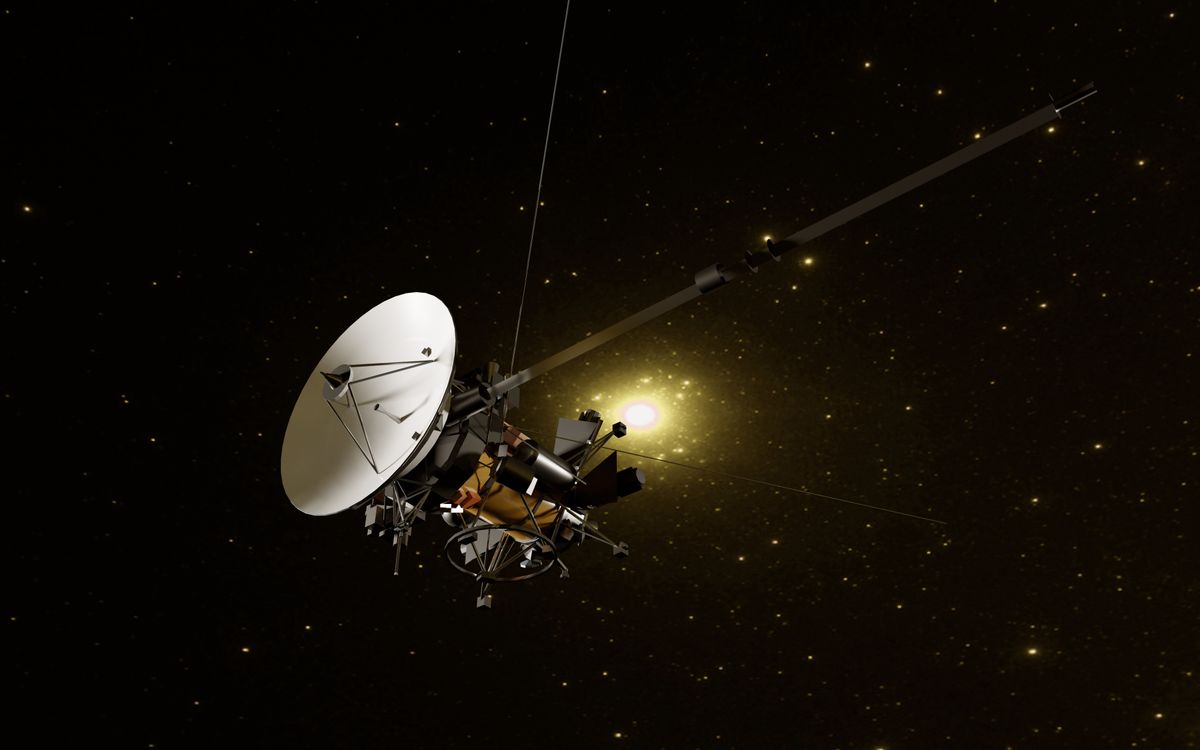
This is the strongest reason people wrongly answer is light matter with a yes: surely only "stuff" can shove you. In everyday physics, momentum is mass times velocity — so a massless thing would seem to have none. But light plays by relativity's rules, where a particle's momentum is tied to its energy: p = E/c. A photon has energy, so it has momentum, and when light strikes or reflects off a surface it delivers a tiny shove called radiation pressure. You never feel it, but it's real and measurable. It's strong enough to push a solar sail — a spacecraft that "sails" on sunlight with no fuel — and it helps blow the tails of comets out away from the Sun. (Radiation pressure is light's push made useful.)
Why must massless light travel at the speed of light?
This is the strangest consequence of being massless. Light doesn't just happen to travel at 299,792,458 metres per second — it has no choice. Anything with zero rest mass can only ever move at that one speed.
Here's the key idea. Mass is a kind of resistance to changing motion. A massive object can sit at rest, and it takes more and more energy to push it faster, which is why nothing with mass can reach the speed of light. A massless photon has none of that resistance and no anchor to a state of rest, so it's locked at the cosmic speed limit from the instant it's created until the instant it's absorbed. It can never slow down or stop — only exist, moving at c. (Wikipedia's article on the photon covers its massless, ever-moving nature.)
Light vs matter: the key differences
So light and matter are two genuinely different things. Here's the contrast at a glance:
| Property | Matter | Light |
|---|---|---|
| Made of | Atoms (protons, neutrons, electrons) | Photons |
| Rest mass | Yes | None (zero) |
| Takes up space | Yes | No fixed volume |
| Can be at rest | Yes | Never — always moves at c |
| Carries energy | Yes | Yes (E = hf) |
| Carries momentum | Yes (mass × velocity) | Yes (p = E/c) |
| Top speed | Always below c | Exactly c |
The headline, through E = mc², is that matter and light are two faces of the same coin — energy. Matter is energy locked up as mass and standing still; light is energy set free, carrying no mass and never resting. (Mass–energy equivalence is the bridge between them.)
One original diagram for this article: a two-column "matter vs light" portrait — on the left, an atom with a labelled nucleus and electrons, marked "has mass, can rest"; on the right, a photon drawn as a moving wave-packet, marked "no mass, always at c" — joined by a central arrow labelled "E = mc²" showing energy as the thing they share.
Want to keep going? See what light energy is, the types of light across the spectrum, or browse all our optics guides.
Frequently Asked Questions
Is light matter?
No. Matter is anything that has mass and takes up space — atoms, molecules, you, the air. Light is made of photons, which have zero rest mass and occupy no fixed volume, so light is not matter. It is a form of energy, electromagnetic radiation, rather than a substance you could weigh or hold.
Does light have mass?
Light has no rest mass — a photon at rest would weigh nothing, and in fact a photon can never be at rest. It does have energy and momentum, and through E = mc² that energy has a tiny equivalent 'mass', which is why light is bent by gravity. But it carries no matter and cannot be put on a scale.
If light has no mass, how does it carry energy?
Energy doesn't require mass. A photon's energy is set entirely by its frequency, E = hf, not by any weight. An ocean wave carries energy to the shore without any water crossing the ocean; light does the same, delivering energy when it is absorbed even though nothing material travels with it.
Can light push objects if it has no mass?
Yes. Light carries momentum, p = E/c, so when it hits or reflects off a surface it exerts a tiny push called radiation pressure. The effect is minuscule in daily life but real — it is what drives solar sails through space and helps shape the tails of comets.
Why does light always travel at the speed of light?
Because it is massless. Anything with zero rest mass has no inertia to hold it back and can only travel at one speed — 299,792,458 metres per second in a vacuum. A massless particle can never speed up, slow down, or stop; it exists only at the cosmic speed limit.

About Umar Farooq
Umar Farooq writes in-depth guides on the physics of light and optics — from reflection, refraction, and lenses to diffraction, lasers, and fiber optics, explained from first principles.
Read more about Umar Farooq →