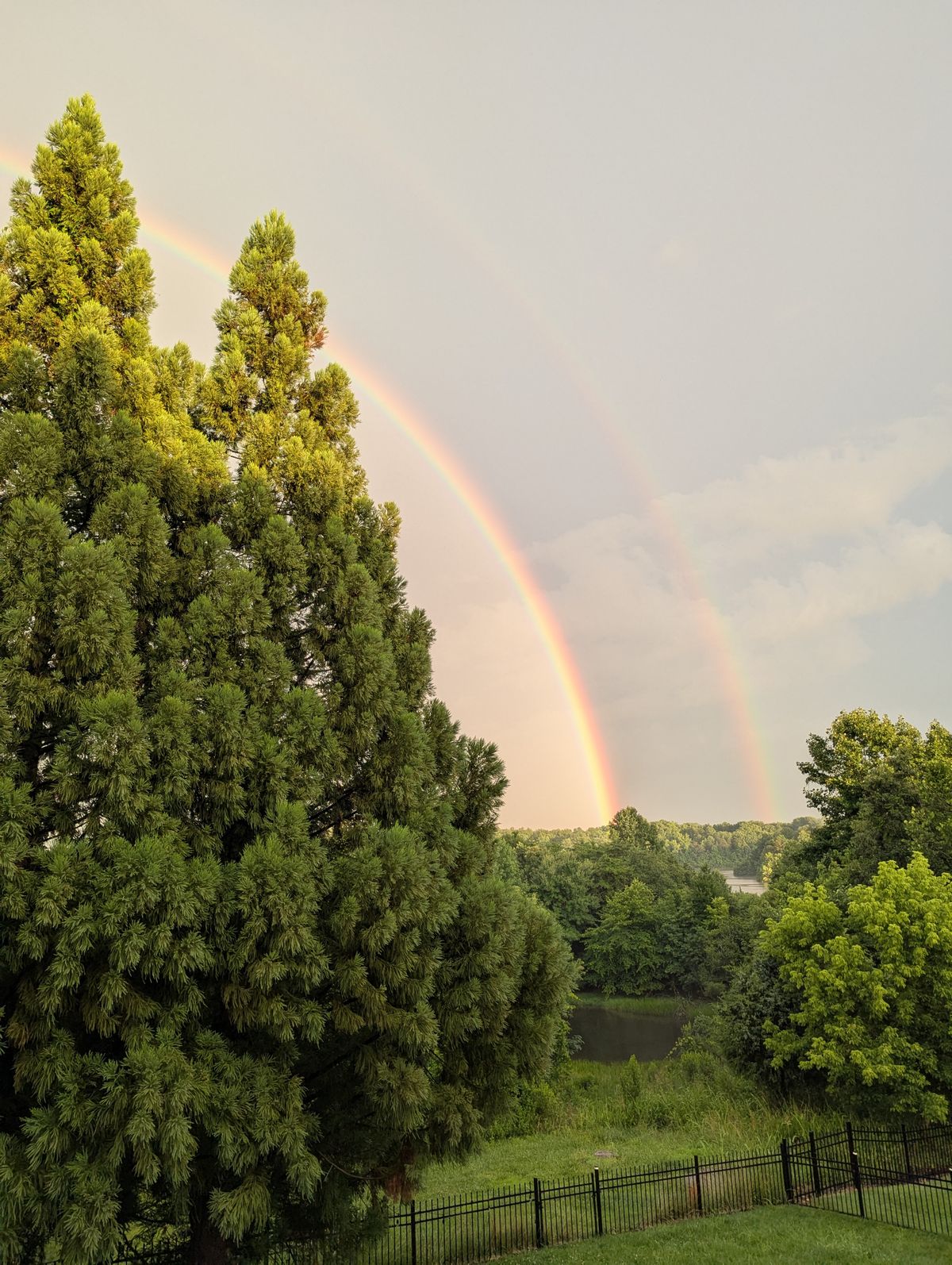
A double rainbow is caused by two internal reflections of sunlight inside raindrops. The first reflection produces the bright primary bow you are familiar with at about 42 degrees from the antisolar point. The second reflection produces a fainter secondary bow about 10 degrees further out, at roughly 51 degrees, with the colours reversed.
Here is what we cover: exactly what causes a double rainbow, how the primary and secondary bows differ, why the colours are reversed, what Alexander's dark band is, how to spot one, and the surprising truth about how rare they really are.
What Causes a Double Rainbow? The Two-Reflection Answer
Picture a raindrop as a tiny glass sphere. Sunlight enters it, bends (refracts), and either passes straight through or reflects off the inside back surface. Most of the light goes straight through — but some of it hits the back wall at just the right angle to bounce back toward you. That single internal reflection is what gives you the primary rainbow.
What causes a double rainbow is a second internal reflection. After the light reflects once, instead of exiting the droplet, it bounces off the inside surface a second time before finally leaving. That extra bounce sends the light out at a steeper angle — about 51 degrees from the antisolar point instead of 42 — which is why the secondary arc sits above the primary one.
Think of it like a pinball inside a spherical machine. One bounce sends the ball out one way. Two bounces redirect it at a different angle entirely. The physics is the same for every raindrop in the shower, so billions of droplets working together paint a complete second arc in the sky.
This double-reflection explanation was first worked out by René Descartes in 1637. Using a large glass sphere filled with water, he traced the paths of individual rays and correctly calculated the angles for both bows — a century before Newton explained the colours.
Primary Rainbow vs Secondary Rainbow: Key Differences
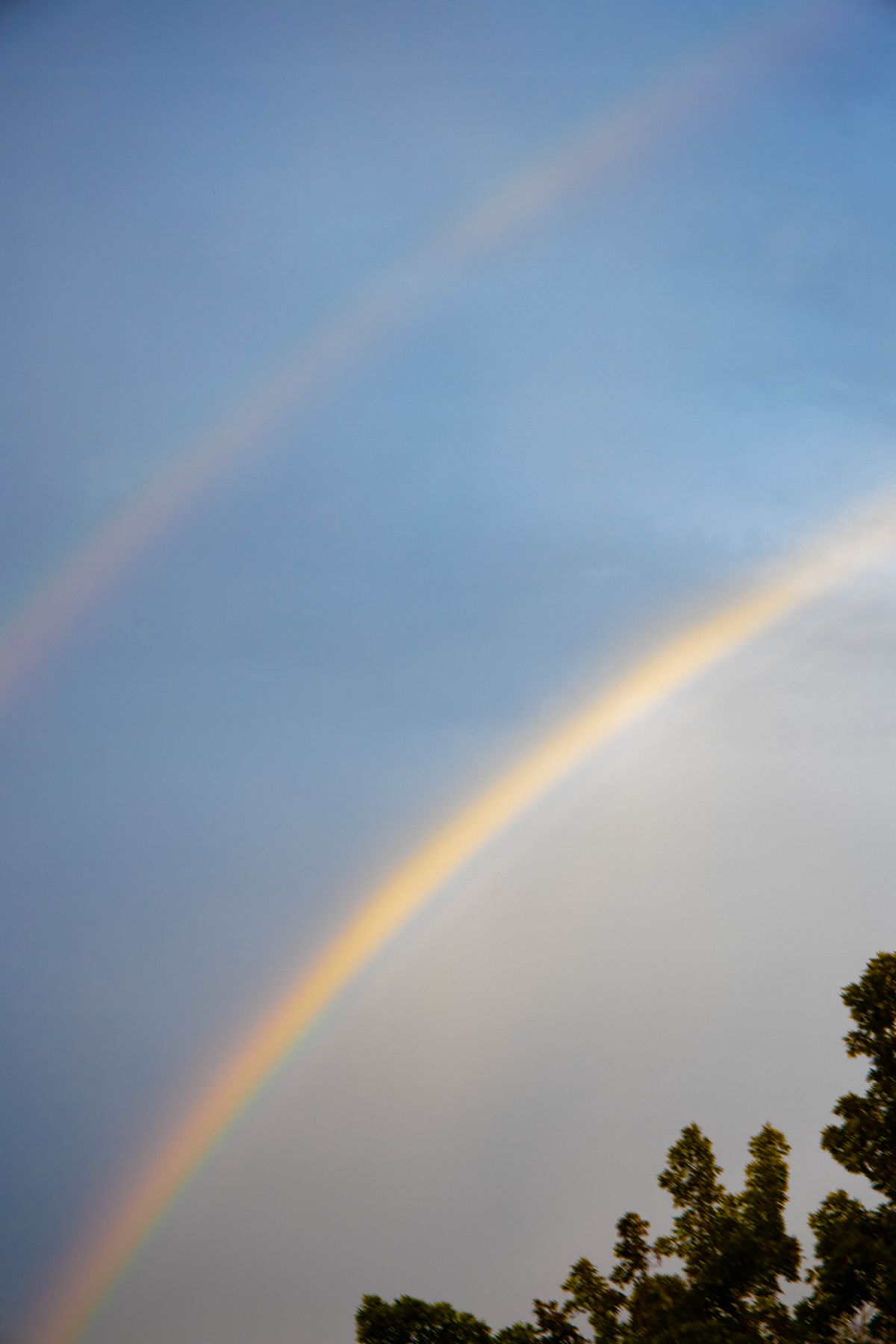
The primary and secondary rainbows are not just copies of each other. They differ in angle, brightness, colour order, and width.
| Feature | Primary Rainbow | Secondary Rainbow |
|---|---|---|
| Internal reflections | 1 (single bounce) | 2 (double bounce) |
| Angular radius | About 42° (red 42°, violet 40°) | About 51° (red 50°, violet 53°) |
| Colour order | Red on the outside, violet on the inside (ROYGBIV) | Violet on the outside, red on the inside (VIBGYOR) |
| Brightness | Bright, vivid | Fainter — about 1/10th the intensity |
| Width | Narrower, typically 2° | Wider, about twice as wide |
| Location | Lower arc | Upper arc, about 10° above the primary |
The secondary bow is always there in theory — every rainbow is technically a double rainbow. But you need the right conditions to see it.
Why Are the Colours Reversed in a Double Rainbow?
The colours are reversed in a double rainbow because the second internal reflection inverts the beam. Here is why.
Different colours of light refract by different amounts when they enter water. Violet (shorter wavelength) bends most; red (longer wavelength) bends least. In the primary bow, this means red emerges at a steeper angle (about 42 degrees) than violet (about 40 degrees), which is why red sits on the outer edge.
But in the secondary bow, the light path is folded by an extra reflection. The total deviation from the incoming sunlight is more than 180 degrees — about 230 degrees total. At these large angles, the ordering flips. Red, which deviates least, now appears on the inside edge at about 50 degrees, while violet, which deviates most, appears on the outside at about 53 degrees.
The result is that the secondary rainbow reads VIBGYOR from inside to outside — the exact reverse of the primary's ROYGBIV. If you see a double rainbow, look carefully: the colours of the upper arc are mirrored.
Why Is the Secondary Rainbow Fainter?
Two reasons.
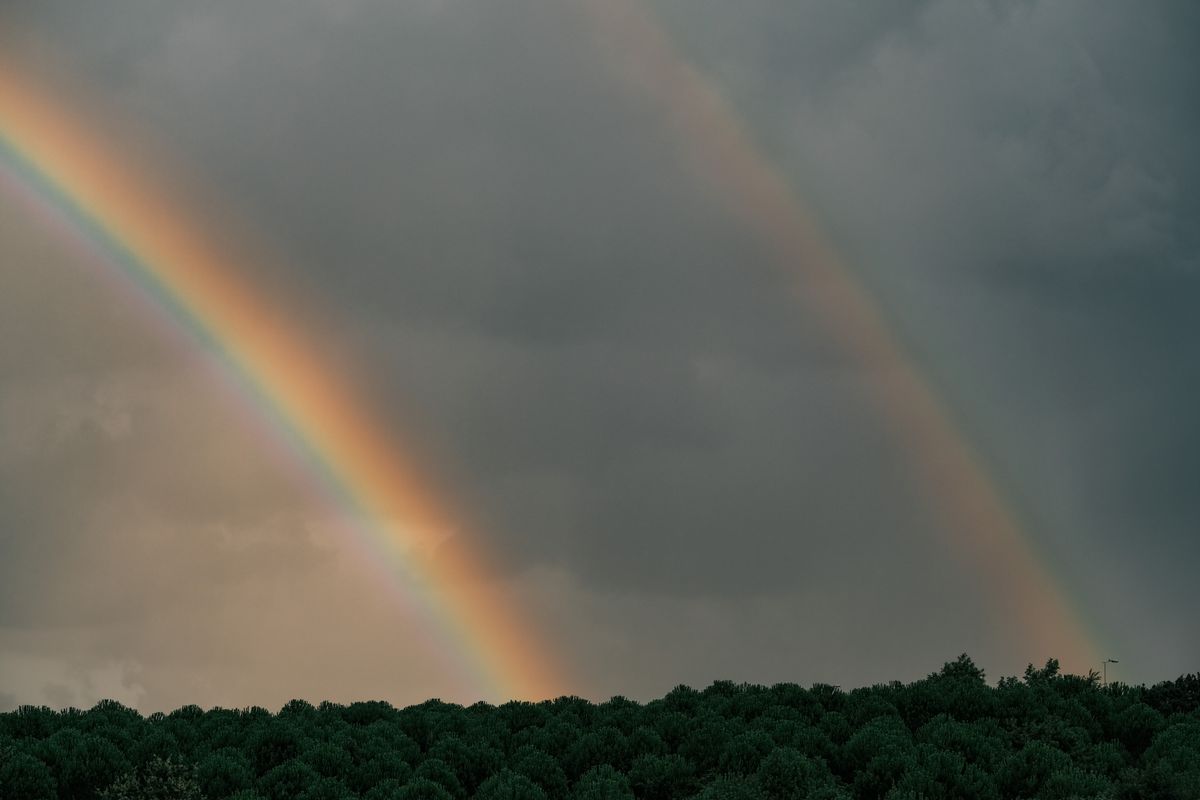
First, every time light hits the inside surface of a raindrop, some of it transmits through instead of reflecting. A single-reflection ray loses some light at that one bounce. A double-reflection ray — what causes a double rainbow — loses light at two bounces, so far less makes it out toward your eyes. According to Schaaf's measurements, the secondary bow is roughly one-tenth the intensity of the primary under the same conditions.
Second, the secondary bow is spread across a wider area of sky — about twice as wide as the primary — so the same amount of light is diluted over a larger region.
This is why double rainbows are most visible when the raindrops are medium to large (1 millimetre or more in diameter). Larger drops produce brighter, narrower bows, making the fainter secondary arc easier to spot.
What Is Alexander's Dark Band?
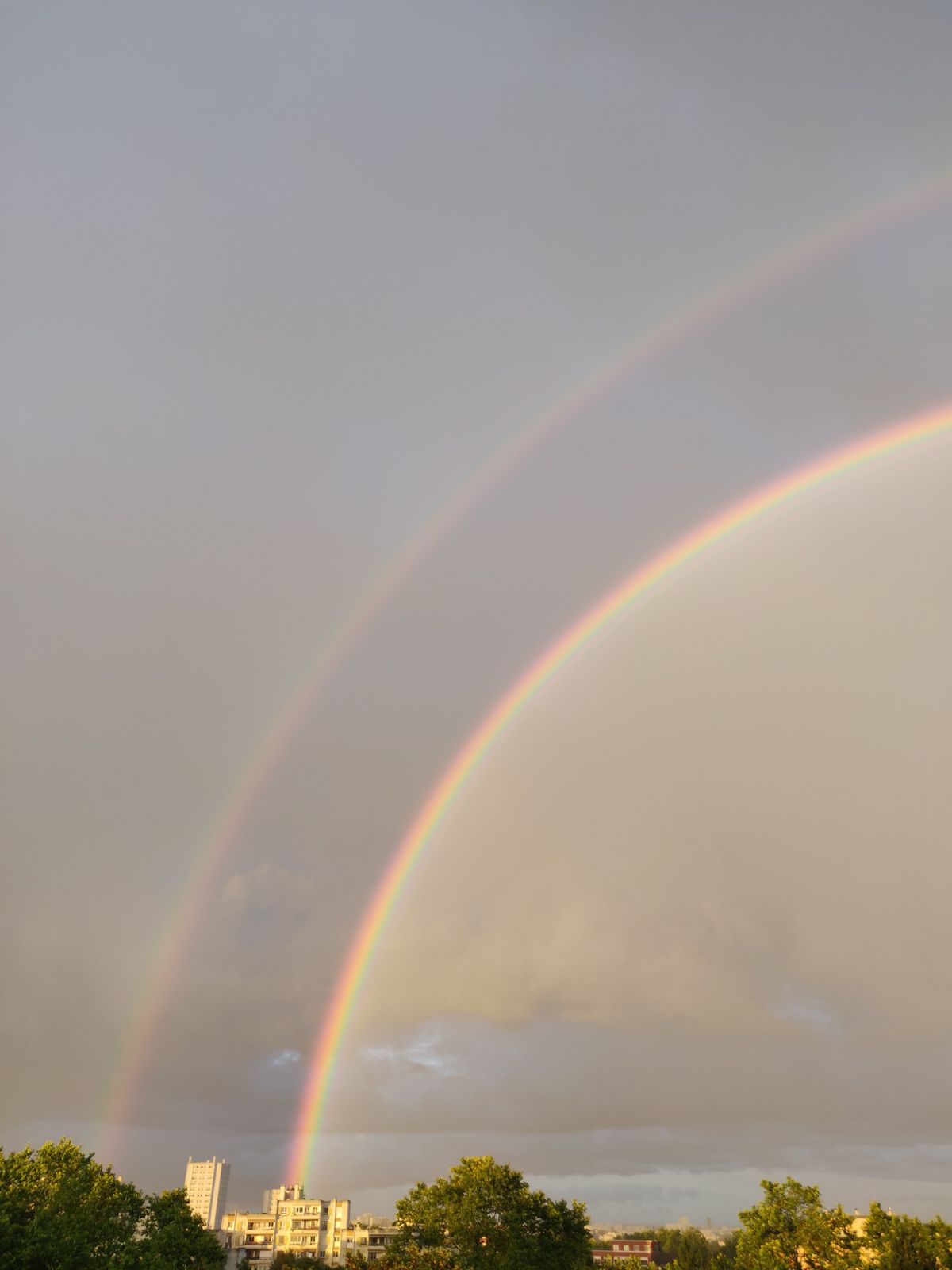
Look at a double rainbow on a clear day and you will notice the sky between the two arcs looks darker than the sky either side. That is Alexander's dark band, named after Alexander of Aphrodisias, who first described it in roughly 200 AD.
The dark band is a direct geometric consequence of what causes a double rainbow. Light that reflects once inside raindrops is redirected into a cone between about 40 and 42 degrees. Light that reflects twice is redirected into a separate cone between about 50 and 53 degrees. Between 42 and 50 degrees — the gap between the two cones — no rainbow light from either process reaches the observer. The sky in that band is lit only by ordinary scattered skylight, making it appear noticeably darker.
The effect is subtle but unmistakable once you know to look for it.
How Rare Are Double Rainbows?
Double rainbows are not as rare as popular culture suggests. In theory, every rainbow is a double rainbow — the secondary arc is always formed alongside the primary one. The question is whether you can see it.
You need three things for a visible double rainbow:
- The sun behind you, less than about 42 degrees above the horizon (early morning or late afternoon).
- Moderately large raindrops — at least 0.5–1 mm in diameter. Smaller drops produce dimmer bows, and the already-faint secondary arc disappears.
- Clear sky behind the rain — thick clouds can obscure the fainter secondary light.
If you see a primary rainbow under these conditions, there is a good chance the secondary is there too. Tilt your head up — it is about 10 degrees higher in the sky than the primary, with its colours reversed.
A Common Misconception About Rainbows
Many people believe that a rainbow is a flat arc that touches the ground somewhere in the distance. "A rainbow is a flat arc you could reach" is one of the most persistent myths in optics.
In reality, a rainbow is not a flat arc. It is a cone of directions — a 42-degree cone centred on the antisolar point (the point directly opposite the sun), and it is personal to each observer. The person standing next to you sees their own rainbow, formed by a different set of raindrops. There is no spot where the rainbow "lands," and you can never reach it. No two people ever see exactly the same rainbow.
The secondary rainbow is the same: a fainter 51-degree cone, equally personal, equally unreachable.
External Resources
- Atmospheric Optics: Secondary Rainbow — detailed ray diagrams, photographs, and explanations of the secondary bow and higher-order rainbows
- HyperPhysics: Primary and Secondary Rainbows — concise physics reference with angle calculations and Descartes' original geometry
- Wikipedia: Rainbow — comprehensive article covering history, physics, cultural significance, and related phenomena
For the physics that makes rainbows possible, see how refraction through a prism splits white light into colours. Read about reflection of light examples to see how internal reflection creates optical effects in nature. For a deeper look at how the eye perceives these phenomena, see our guide on how does a lens work.
Frequently Asked Questions
What causes a double rainbow in simple terms?
A double rainbow happens when sunlight reflects twice inside a raindrop instead of once. The first reflection creates the bright primary rainbow at about 42 degrees. The second reflection creates a fainter secondary rainbow at about 51 degrees, with the colours reversed — red on the inside, violet on the outside.
Why is the secondary rainbow fainter than the primary?
Each internal reflection loses some light — some escapes out the back of the raindrop instead of reflecting. A second reflection means the light has had two chances to escape, so only about one-tenth as much light reaches your eye for the secondary bow compared to the primary.
Why are the colours reversed in a double rainbow?
The second internal reflection inside the raindrop inverts the beam. Red light refracts least, so in the primary bow it appears on the outside. But because the secondary bow is formed by light that has undergone an additional reflection, the least-deviated red light ends up on the inside edge, reversing the entire colour order.
What is Alexander's dark band?
Alexander's dark band is the noticeably darker strip of sky between the primary rainbow (at about 42 degrees) and the secondary rainbow (at about 51 degrees). No rainbow light from single-reflection or double-reflection paths reaches the observer in this angular gap, so the sky appears darker there.
How rare are double rainbows?
Double rainbows are not as rare as people think. In theory, every rainbow is a double rainbow — the secondary bow is always there, but it is often too faint to see. You need moderately large raindrops and the sun low behind you (below about 42 degrees above the horizon) for both bows to be visible.

About Umar Farooq
Umar Farooq writes in-depth guides on the physics of light and optics — from reflection, refraction, and lenses to diffraction, lasers, and fiber optics, explained from first principles.
Read more about Umar Farooq →