Mirrors
8 articles on mirrors, sorted newest first.

Real vs Virtual Image: 7 Clear Differences (Complete Guide)
A real image forms when light rays actually converge at a point — you can project it on a screen. A virtual image forms where light rays only appear to diverge from a point — you cannot capture it on a screen. Real images are inverted; virtual images are upright. Concave mirrors and converging lenses can produce both types; plane mirrors, convex mirrors, and diverging lenses produce only virtual images. Here are the 7 key differences between real and virtual images, with examples from every common optical device.

Plane Mirror: 5 Surprising Properties of Plane Mirror Images
A plane mirror is a flat reflective surface that forms a virtual, upright image the same size as the object. The image appears as far behind the mirror as the object is in front, and it is laterally inverted — left and right swap places. Unlike curved mirrors, plane mirrors never magnify, shrink, or distort the image. Here are the 5 properties of plane mirror images, how to draw their ray diagrams, and where they are used every day.

How Does a Mirror Work? The Physics of Reflection in Mirrors
A mirror works by reflecting light at the same angle it arrives, following the law of reflection. A thin metal coating (silver or aluminium) behind a glass sheet absorbs and re-emits photons almost perfectly, creating a clear image. Here is how mirrors are made, how each type forms images, and why your reflection is flipped front-to-back, not left-to-right.

Convex Mirror: Complete Guide to 5 Uses & Examples
A convex mirror is a curved mirror where the reflecting surface bulges outward like a dome. It diverges parallel light rays so they appear to come from a focal point behind the mirror. Because it always produces an upright, diminished image with a wider field of view, it is the standard for vehicle rearview mirrors, security mirrors, and traffic safety mirrors. Here is how convex mirrors work, their ray diagrams, image formation, mirror formula, and everyday uses.

Converging vs Diverging Mirror: Is Concave Always Converging?
A converging mirror (concave) bends light inward to a focal point. A diverging mirror (convex) spreads light outward. Converging mirrors can form real images; diverging mirrors always form virtual ones. Here is why a concave mirror is always converging, a convex mirror is always diverging, and how to remember which is which.

Concave vs Convex Mirror: Differences, Uses & Diagrams (Comparison)
Concave mirrors curve inward and converge light to a focus, producing real or virtual images. Convex mirrors curve outward and diverge light, always producing virtual, upright, diminished images with a wider field of view. Here are the key differences between the two types of spherical mirrors, with comparison tables for image formation, ray diagrams, applications, and a simple trick to remember which is which.

Concave Mirror: Complete Guide, Working, 6 Image Cases & Uses
A concave mirror is a curved mirror where the reflecting surface curves inward like a cave. It converges parallel light rays to a single focal point in front of the mirror. This ability to focus light makes it essential in telescopes, headlights, shaving mirrors, dental mirrors, and solar furnaces. Here is everything you need to know about concave mirrors, from ray diagrams to image formation to the mirror formula.
How to Draw Ray Diagrams for Mirrors (Step-by-Step Guide)
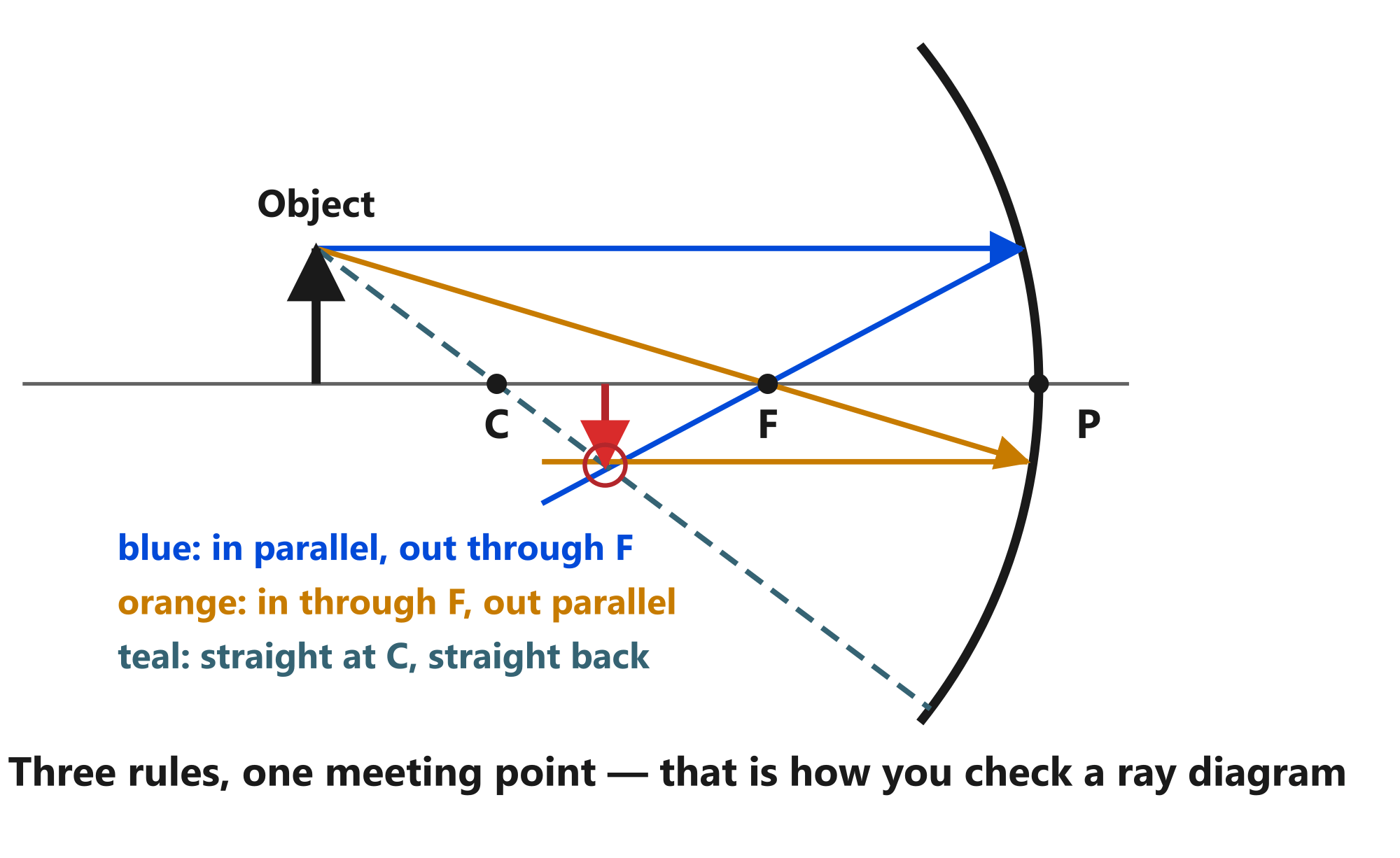
A ray diagram traces the path of light from an object to a mirror to determine where an image forms. Drawing a concave mirror ray diagram takes just four steps: set up the mirror and axis, draw two incident rays, reflect them using the rules, and mark where they meet. This guide covers those steps for every object position for both concave and convex mirrors, plus the common mistakes that trip students up.